O Teu Próximo Passo / The conversation continues
The book ends.
The conversation continues.
Ten perspectives from the book — and a place for readers to share what its questions prompted them to reconsider.
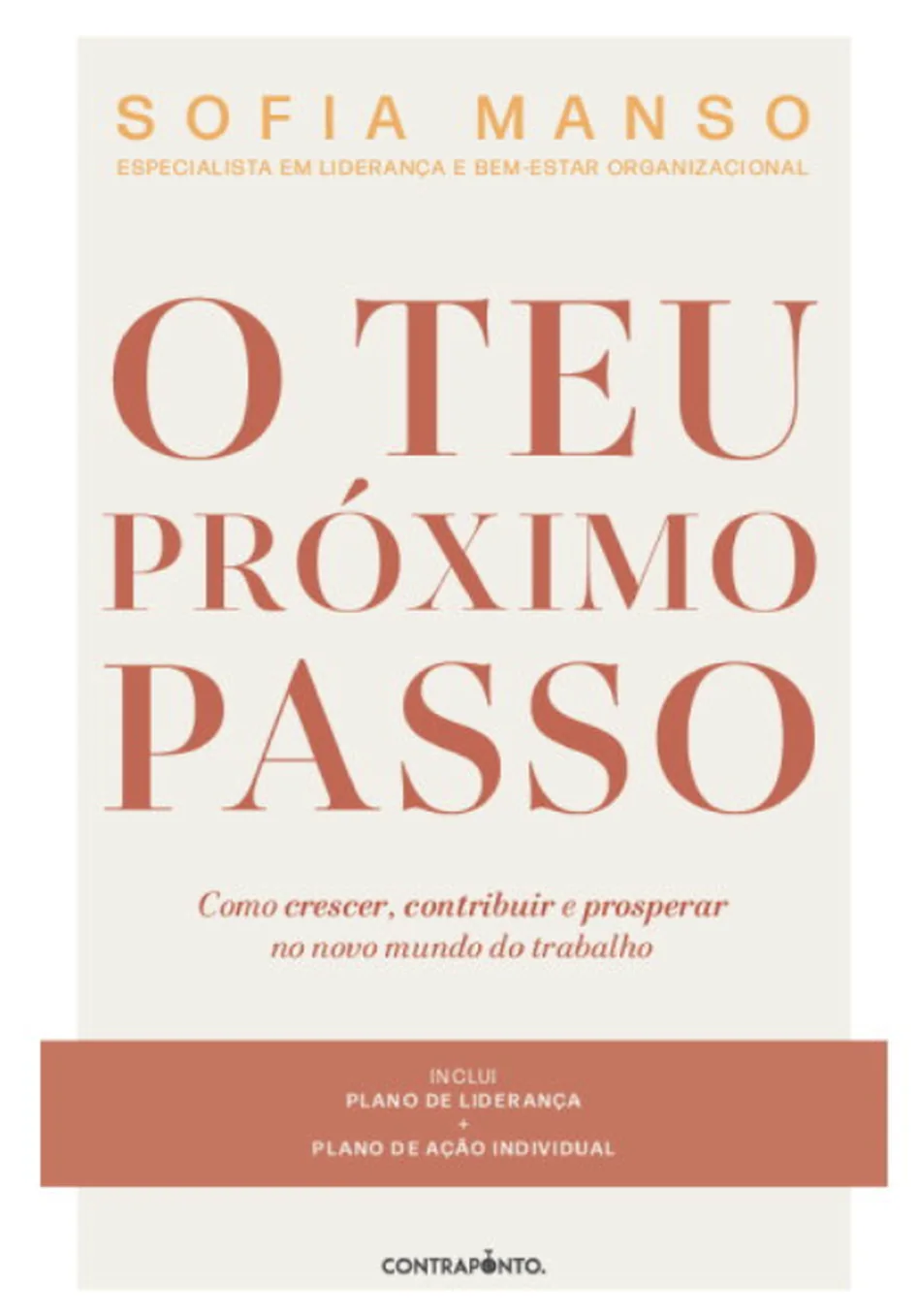 ONE BOOK. MANY PERSPECTIVES.
Ten perspectives. No easy answers.
The afterword brings together ten very different voices around one question: what place should work — and the decisions it demands — have in our lives?
English translations of the original Portuguese afterword contributions.
01 / 10Ana Pinto
Head of Learning & Development, MEO
“Some people have a gift for turning intention into action, simply through who they are.”Read the full reflectionClose reflection
Ana Pinto
Head of Learning & Development, MEO
Some people have a gift for turning intention into action, simply through who they are. Sofia is one of them.
Over the course of my career, I have come to realise that one of the most distinctive abilities is bringing ideas to life — ideas that anyone might have, but that few can put into practice. While many professionals choose to analyse, weigh up options and wait for the right moment, Sofia is already moving ahead, breaking new ground and building a path. She has an extraordinary ability to start difficult conversations, choose what matters, bring people together around a purpose bigger than herself and make a convincing case for what matters.
This book reflects all of that: practical, inspiring and focused on action. Beyond exploring change and growth, it helps readers take the next step.
If there is one thing I keep learning from Sofia, it is this: the next step is up to us. It happens when someone decides to move forward — or to stay, when that makes sense. Sofia reminds us to start with what matters most — and let that shape what comes next.
Afterword · p. 235
02 / 10Anselmo Crespo
Head of New Content, TVI/CNN Portugal
“Does professional success define who we are?”Read the full reflectionClose reflection
Anselmo Crespo
Head of New Content, TVI/CNN Portugal
Does professional success define who we are?
My generation was shaped, to some extent, by the idea that we are what we achieve professionally. Money, status and even happiness came to be measured by how far our careers had taken us. This helps explain why so many personal and family plans were postponed: marriages later in life — or, worse, a string of divorces — and children born later, often growing up far from their grandparents.
We had to work hard, be constantly available and give up a great deal to reach the next rung. From intern to professional. From professional to manager. From manager to director. Only then could our salary grow, and only then would we be considered worthy of respect.
That paradigm is changing. For younger generations, work is just one part of life. It is not the only part, and often not the most important. This new reality reflects social progress, but it also brings risks that cannot be explored within a few paragraphs.
One thing seems obvious to me: if we allow professional success alone to define us, we will undoubtedly become a society with narrower horizons and less happiness.
Afterword · pp. 235–236
03 / 10Carlos Brito
President, Portuguese Order of Economists (Northern Region)
“Change is not necessarily progress.”Read the full reflectionClose reflection
Carlos Brito
President, Portuguese Order of Economists (Northern Region)
We live in an age of constant change. Yet change is not necessarily progress. Real transformation begins when we stop asking only 'what needs to change?' and start asking 'what for?' It is this search for meaning that distinguishes organisations that merely react from those that consciously build the future.
For decades, we believed that demanding more would automatically produce better results. Today we know that sustainable performance depends less on pressure than on the quality of relationships, trust and the ability to find meaning in work. It is not about lowering standards, but giving them a purpose.
The organisations that thrive are not necessarily those with the greatest resources. They are those that create environments where people feel their contributions matter and that they are part of something larger than themselves. When this happens, commitment ceases to be imposed and becomes a choice.
This is where leadership's real challenge lies: creating the conditions in which everyone can fulfil their potential while combining professional achievement with personal growth. The best leaders are not those who can extract more from people, but those who enable people to give their best. Because when people grow, organisations grow with them.
That is precisely why Sofia Manso's O Teu Próximo Passo is such a relevant book. At a time when quick answers and simplistic formulas abound, the author asks us to do something far more demanding: stop, think and understand before deciding. By bringing the debate back to people, organisations and the quality of decisions, this book reminds us that the true next step is not simply a change in direction, but rediscovering the purpose that gives meaning to our choices, our leadership and organisational transformation.
Afterword · pp. 236–237
04 / 10Eduardo Barroso
Doctor
“Once I understood what needed to change and created the conditions for it, progress followed steadily.”Read the full reflectionClose reflection
Eduardo Barroso
Doctor
The book is organised in three parts — See Clearly, Decide and Move Forward — and that mirrors my own experience. More than thirty years ago, I woke up to an undeniable reality. No general surgeon could be equally competent in every field covered by the specialty. I had to choose and concentrate my knowledge and experience in a more specialised area, one that would allow a larger clinical caseload and stronger training capacity.
Recognising that reality meant deciding to create the physical, technical and human conditions to make it happen, practically from scratch. Above all, it meant changing the clinical decision-making process, so that the overall treatment strategy became the result of a multidisciplinary, collective decision. Having recognised the new reality and decided to move forward by creating the necessary conditions, progress followed naturally and steadily.
Building one of Europe's largest centres for treating complex and challenging hepatobiliary and pancreatic diseases was my life's work, and an enormous benefit to thousands of people. It demanded years of work, a clear sense of purpose and difficult decisions in the face of systems that were already outdated and dysfunctional. That was my experience. Does that have something to do with what Sofia Manso is asking us to consider in her book?
Afterword · pp. 237–238
05 / 10Ivanilson Machado
President, Grupo Pumangol
“You do not have to be an extraordinary CEO to transform an organisation. You have to be an extraordinary leader.”Read the full reflectionClose reflection
Ivanilson Machado
President, Grupo Pumangol
You do not have to be an extraordinary CEO to transform an organisation. You have to be an extraordinary leader — someone who can see a future where others still see only day-to-day operations, build trust where there is uncertainty, and turn individual talent into collective strength.
Working in the Angolan market calls for particularly clear-sighted leadership. It is a context of tremendous potential, marked by transformation, ambition and the responsibility to establish today the standards that will define tomorrow. Here, leadership is not only about managing the present. It is about helping to shape a country's future.
O Teu Próximo Passo confronts us with a crucial question: how many systems continue to function because someone quietly makes up for what has not yet been clearly designed? Results matter, but they never tell the whole story. No result is truly sustainable when it demands that people become smaller so that the organisation can appear bigger.
My greatest ambition is for people to experience such a deep sense of wellbeing that the culture runs through their veins, with the same vitality with which they put it into practice. I do not simply want them to know the culture. I want them to feel it.
As leaders, we have that responsibility. A job title may put us at the head of an organisation. Only leadership allows us to take it further. And a leader's true legacy lies in the people they help to grow, the culture they bring to life and the future they help to build.
Full contribution to the afterword
06 / 10Lara Sousa Dantas
Founder, Quintal de Flor · Forbes Under 30
“And that matters more than any destination.”Read the full reflectionClose reflection
Lara Sousa Dantas
Founder, Quintal de Flor · Forbes Under 30
Some people carry their name. Others turn it into destiny.
Sofia is Passos — a surname that means “steps”. I can think of no name that suits her better. Her story is one of taking the next step, again and again. Not always easy or light steps, but steps she never stops taking.
Some people think courage means not being afraid. I believe courage is precisely the opposite. It is feeling fear tightening in your chest and still taking another step. Falling, taking a deep breath and getting back up. Looking ahead when everything around you urges you to give up.
And that is what I see in her.
A woman who thinks carefully about every step. Not because she is afraid to live, but because she understands the weight of choices. She has learnt that life is not measured by how quickly you arrive but by the strength with which you carry on.
Sofia has never been one to rush time. She has never needed to run to prove anything to anyone. She walks at her own pace. Sometimes more slowly, sometimes with a determination that seems impossible to stop. But there is one thing she has never done: give up.
And that matters more than any destination.
Everyone applauds the winners. Few notice the people who persist. Those who cry quietly, dry their tears and smile again. Those who feel lost but keep looking for a path. Those who have days when their hearts weigh a tonne and still find the strength to take another step.
That is what it means to keep taking the next step.
It means not standing still when life pushes you backwards. Turning scars into learning. Accepting that not every road is straight, and that the longest detours can lead to the most beautiful places in our story.
Sofia never walked because she was in a hurry to arrive. She walked because she understood that stopping would mean giving up hope. And for as long as there is faith, a dream and even a small reserve of strength within her, there will always be another step to take.
Some people leave their mark through their voice. Others through their smile. Sofia leaves hers through the way she faces life. Through the determination she brings to everything she does. Through the dignity with which she bears what nobody sees. Through a quiet courage that needs neither applause nor recognition.
Because truly strong people rarely make a noise.
I now realise that what is most beautiful about her was never the destination. It was always the journey.
The stumbles that did not define her. The falls that did not hold her back. The doubts that never robbed her of the will to continue.
Without saying a word, Sofia teaches us that living does not mean never falling. It means getting up again. Believing when everything seems lost. Continuing when it would be easier to stop.
And that is why, to me, she will always be a woman who keeps taking the next step.
Not because she is in a hurry to reach the end.
But because she never gave up walking.
And perhaps that is the most beautiful kind of courage: carrying on even when no one understands how hard it is to take the next step.
Because ultimately it is not our destinations that define us.
It is the steps we choose to take, even when the road seems impossible.
Afterword · pp. 238–240
07 / 10Maria João Pires
Director of Marketing, Communications and Customer Experience, Caetano Auto
“The strongest companies will be those that keep growing without losing their people along the way.”Read the full reflectionClose reflection
Maria João Pires
Director of Marketing, Communications and Customer Experience, Caetano Auto
Over the past few years, I have seen how deeply work has changed — not only how we work, but how people feel within their workplaces.
We live in a time of intense demands, speed and relentless pressure. For a long time, almost without realising it, we valued most those who endured the most, were always available and solved every problem without stopping. Today, though, I believe results alone can no longer tell us whether an organisation is truly doing well.
The strongest companies will be those that keep growing without losing their people along the way. That calls for more conscious, more consistent and more humane leadership.
That is what I felt when reading Sofia Manso's book: her ability to articulate the tensions so many people experience quietly at work, and to make us question what we have normalised for far too long.
At heart, this book reminds us of something simple but important: behind every strategy, result or business, there are still people. And perhaps that is exactly where the next step begins.
Afterword · p. 240
08 / 10Miguel Pina Martins
Founder, Science4you and Game Changers
“Some books try to offer quick answers. This is not one of them. And that is a good thing.”Read the full reflectionClose reflection
Miguel Pina Martins
Founder, Science4you and Game Changers
Some books try to offer quick answers. This is not one of them. And that is a good thing.
At a time when there is so much talk of productivity, leadership, purpose, artificial intelligence and the future of work, we often fail to ask a simpler, more difficult question: are we working better, or merely enduring more?
This book begins precisely there. It does not romanticise change or push people into hasty decisions. Nor does it make exhaustion an individual problem, as though greater resilience, organisation or adaptability could solve everything. Instead, it helps us look at work more clearly.
And that clarity is essential today.
In companies, teams and careers, far too many situations keep functioning because somebody compensates for what the system has failed to resolve. A lack of clarity, deferred decisions, conflicting priorities, unfairly distributed recognition, cultures that say one thing and reward another. All of this comes at a cost. It may not appear in the figures, but it appears in people.
The merit of this book is to make that cost visible without resorting to easy rhetoric. It shows that the next step is not always to leave, break away or change everything. Sometimes it is to understand better. Sometimes to renegotiate. Sometimes to set a boundary. Sometimes to stay, but more consciously. What matters is to stop operating on autopilot.
For leaders, this book is also a warning. The future of work will not be solved by technology, processes or new tools alone. It calls for better systems, better decisions and a more honest relationship between expectations, responsibility and human sustainability.
In a world where everyone seems to be rushing, the book invites us to stop long enough to ask: what am I sustaining, at what cost, and what next step can I no longer afford to postpone?
That question alone makes the book worth reading.
Afterword · pp. 241–242
09 / 10Rui Piteira
B2B & Communications Programmes Manager, Philip Morris International
“Me. You. Us.”Read the full reflectionClose reflection
Rui Piteira
B2B & Communications Programmes Manager, Philip Morris International
Me. You. Us.
At the heart of every organisation are people: they have the power to transform work, challenge systems that no longer serve their purpose, and develop new ways of making decisions and acting with meaning. When we measure a team’s value not only by what it delivers but also by the hidden human cost of that delivery, we create room for more conscious, sustainable and genuine choices. The future of work will not be designed by rigid structures but by people who dare, together, to question, redefine and act — so that the next step is no longer a solitary answer but a collective endeavour where every person matters and everyone counts.
Thank you, Sofia, for never stopping challenging us. Together, we can do more and better.
Afterword · p. 242
10 / 10Zita Freire
Entrepreneur, trained in Cognitive and Behavioural Neuroscience
“She does not tell the reader what to decide; she helps them examine the architecture behind their exhaustion.”Read the full reflectionClose reflection
Zita Freire
Entrepreneur, trained in Cognitive and Behavioural Neuroscience
O Teu Próximo Passo begins with a simple, painfully recognisable idea: the exhaustion felt by so many capable people does not arise from personal weakness, but from work systems that demand endless availability as proof of worth. Before we realise it, identity merges with expected performance, until taking a break feels like guilt and setting a limit seems like failure. The book offers a method in four movements that turns this invisible compensation into judgement and conscious choice.
We live with this tension every day, caught between wanting to show results and the urgent need to remain connected to our purpose. I recognise myself, uncomfortably, in those who measure their own worth by how useful they prove to be. That is why I advocate human-centred leadership grounded in neuroscience: understanding the mechanisms of stress and emotional regulation helps create more balanced leadership, where people can contribute freely without constantly proving their worth.
Sofia Manso writes with the authority of extensive experience in this field and rare analytical rigour. She does not tell the reader what to decide; she helps them examine the architecture behind their exhaustion. An honest invitation to conscious action.
Afterword · pp. 242–243
The ten afterword contributions from O Teu Próximo Passo, published by Contraponto.
What stays with readers.
“I wish this book had been around years ago.”
Shared with permission, translated from the approved Portuguese reflections. Swipe or use the arrows to read. All new submissions are reviewed before publication.
What stayed with you after reading?
Share something you recognised, questioned or decided to do differently. You can remain anonymous.
No ratings. No formulaic reviews. Just an honest account of what the book made you think about.
The next step is yours to decide.
Explore the book’s method, two practical plans and the questions at its heart.
Buy the book